
blog post. That’s right, if you’re tired of paying for books and magazines, just follow this link to my most recent online publication, a short story titled “Defending the Home Front.” It appears in the most recent edition of Bending Genres magazine. Thanks to editor Robert Vaughan and fiction editor Meg Tuite for recognizing genius when they see it. The story is a whacky take on how local political disputes can lead to over-the-top escalations of response and reprisal. Have at it.
Category: Life as we know it
Responding to a response to a response to a letter sent to the world
I’m not much of a social media person. I like direct contact, which is why I will fire off an e-mail note to someone whose work or other actions has been particularly impressive. I believe in saying “thanks.”
When I recently read a letter to the editor in The New Yorker, I enjoyed the sentiments and felt a parallel with my own experience. So I looked up the writer, and found a web page (so old-school, right?), and (egads!) contact information.
I wrote a note.
And he wrote back.
And so it went.
I’ve pasted our exchange sequentially below. It left me feeling a sense of elation, that people like Ken Bates and his wife are out there in the world, working hard, doing what it takes to make a life — far beyond the inanity of our political yammering classes and their lumpish militants.
(from New Yorker, Nov. 23, 2020)
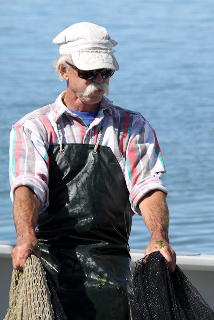 Obamacare and Me
Barack Obama’s memoir of how the Affordable Care Act was passed illuminated the origins of a policy that has affected me profoundly (“The Health of a Nation,” November 2nd). I am a career commercial fisherman. In the nineteen-seventies, when I started working, fishermen and merchant mariners like me had federally supported health coverage through a scheme that had existed for decades. That scheme was terminated, in 1981, by Ronald Reagan. For a time, I bought private insurance, but eventually it became too expensive for my seasonally fluctuating income.
When A.C.A. insurance became available, I quickly signed up. A year later, I had a heart attack, and needed a cardiac stent. The plan I obtained through the health-insurance exchange covered my extensive medical bills and, as a result, my wife and I were able to keep our home, our truck, and our fishing boat.
I am now seventy. This summer, I spent a hundred and ten days on the ocean. No one gets where they are without the help of others. It was a pleasure to read this piece, which illustrated in such detail how I was helped by folks I will never get to meet.
Ken Bates
Eureka, Calif.
(My note to Ken, and our back-and-forth)
Ken
It was so great to see your letter in the current issue of the New Yorker. It mirrored my experience. I had insurance from my business in newspapers for many years, but after I went freelance in 1997, I had to pay my own. Rates kept going up, even though I never claimed a dime. Luckily, I stayed healthy (I work out, run, windsurf).
I watched progress of ACA. Why they waited until 2014, beyond me. But when it arrived, I benefited from supplements and coverage. One benefit was coverage for a colonoscopy after age 50. I got one, it found a large mass in my colon, which surgery removed. It was benign, but could have become cancer.
I’m now 70. I figure I’ve had a glorious additional six years because of the ACA, and even though my surgery under the pre-Medicare insurance cost my wife and me about $11,000 out of pocket, the insurance covered the other $41,000 of the bill. In each of those facts, so much to unpack.
We have been getting screwed by the insurance companies for years. Read “The Bitter Pill” in Time magazine to learn how they have worked the con. The ACA was not perfect (it kept insurance companies in the game), but it got us a step closer to Medicare for All. I’ve got it. Why doesn’t everybody?
Best of health and success to you,
Stu
Good evening Stuart,
Thank you so much for your comments concerning my letter to the editor in the New Yorker and taking the time to track me down. Your story concerning your experience with the ACA is exactly the reason that health care for the American public is so important. I have had the “opportunity” to experience health care costs both ways.
Before the ACA, my wife and I were uninsured, but we have led a very fiscally conservative lifestyle. Through the years we have tried to save as much money as we could. 9 years ago, after spending the summer trolling for salmon on the ocean, the two of us came home, switched fishing gears and proceeded to fish anchovies for 22 days straight, nose to the grindstone and no breaks.
3 days later, I got my hand smashed between two filthy fish bins in the back of a guy’s truck. That led to a MERSA infection, 8 days isolated in the hospital and surgery. Even with a 30% discount with a cash payment, the hospital bill erased most of the income from our summer and fall work.
Again, I really do appreciate the time you have taken to contact me. I am curious about your newspaper and writing work and where you wind surf. I have board surfed since fifth grade. Linda and I usually take a month in February to surf and hike in the desert in Baja California. The two of us live on a small island in Humboldt Bay. It has been frosty the last couple of nights and we expect it will be a cold one tonight. It is probably chilly where you are too.
Stay warm and stay healthy,
Ken and Linda
Ken,
So good to get your note, and so sad to read of your encounter with the medical-insurance complex. What a tragedy, that someone who can work so hard to make a buck finds it stolen because of an accident for which he needs care. I say stolen, because I believe that is what it is. The people who fixed your hand did a good job, and probably got a decent check for it. But the real theft was the skim that the hospital took, and all the other expenses they loaded into that bill.
The chief exec at a small hospital in The Dalles makes over $700,000 a year. Does he deserve it? Ha! Guess I know the answer.
Yours sounds like a lovely life, nonetheless. I would love to meet you and Linda some day. I almost went to school at Humboldt, shifted to Southern Oregon, finished my journalism studies at Oregon. Ended up back in Ashland for 14 years, working at the Medford paper, hiking all over southern Oregon and northern California. Love it down there.
When I was a kid, I wave-surfed in SoCal, but too many people for me back in the late ’60s, so I ran away to Oregon and never looked back.
My wife and I are taking a winter break to spend some time in Summerland, south of Santa Barbara. No plans for our return route. If we detour along the coast, I’ll give a call. Maybe we can grab a beer (if the Covid situation permits).
Best to you both,
Stu
Good morning,
If Linda and I had to pick a place to hang out in Southern California, it would be Summerland. I grew up surfing on that stretch of coast, and I fished lobsters out of Santa Barbara for about ten seasons. We have a ton of friends there including five or six commercial fishermen that are in our code ( radio) group when we fish salmon every summer.
If you find yourselves driving through Eureka, let us know. We have a guest cabin here on the island, and would be happy to put you up for a night. Otherwise we would love to bring you over to the island for a visit; the only way to get here is by boat.
Happy thanksgiving,
Ken and Linda
A fog from a fire and the fog of arrogance and the fog of incompetence and …
I love fog. I’ve got fog, but I don’t love this fog. This fog is the devil spawn of fire. Smoke, shoved west from its forest home by flames a-billion, then back east by a shift in pressure and wind.
Now it’s ours to enjoy, and not so much the folks to our west. It’s rated hazardous, on the scale of deep breath-to-stop breathing.
North to south, our state is ablaze. Nearly a half-million people have evacuated their homes. They have gone … somewhere. God knows where, but I don’t. They might be at Safeway.
We live just north of Mt. Hood, the blessed 11,000-foot barrier between our county and the burning county to the south. Maybe that county’s residents fled here. It seemed, if that was the case, that they had first decided to stock up in the middle of our Covid-19 pandemic at Safeway.
Mid-day on a September Friday in which nobody was going anywhere for fun, for lolling by a lake, for sipping a beer and dipping one’s toes in chill water, for grilling mashed pork in the skins of mashed pork, I’m standing six deep in a line to buy eight items.
I would love to go camping, but who wants to do that when the smoke is beyond healthy, even for my dog. Satchel tired out earlier than his usual point of fatigue when I took him up into the gloom to chase his sticks and takes his drinks in Indian Creek. (Sorry, that’s its name; no offense intended.)
So we hunker down further, again, more, after months of hunkering from Covid-19. Now we open our doors, and we can see the attacker. We peer out at the smoke lowering like the invasive gloom of a John Carpenter movie (“The Fog”. If Adrienne Barbeau emerges, I’m fine), and wonder if we should inhale, or hold our breaths until all this abates.
Or pack our cars with essentials and legal documents before we flee for our lives.
All that notwithstanding, my wife is off to one of her opportunities to cook. She will endure untold indignities and suffer ridiculous fatigue for the chance to stand before a stove and paint a masterpiece.
She is offering her labors to support a local education foundation. The people for whom she donates time seem to have no clue that it takes a kitchen and utensils and flatware and recycling and trash to make it all happen.
Numerous calls to the winery in charge of provisioning liquid excellence go unreturned. Should my dear show up there to receive their contribution, or not? Eventually, one of their beknighted tribe returns a call.
No, she does not know how many bottles of each wine to assemble for my wife to pick up.
“An email was sent.”
“Sorry, didn’t get it.”
My dear is so restrained. She does NOT say, “Well, talk to the idiot to whom I sent the email and figure it out, because you’ve had a FUCKING WEEK to do that, and I’ll be there in 10 minutes.
No, she says, “thanks for the call.”
At the other end of the line sits the definition of arrogance. If you are paired into an enterprise designed to elevate your brand and share your product, please, do your part. Your wine will not arrive in the glass by divine grace.
No matter, the people who are blessed to view and consume this thoughtfully created meal when it arrives before them will appreciate it mightily. But not nearly enough. If they do, they never say. It is all hay to cattle such as they. The winemaker, for whom a plate was set, fails to show. “Fucking great,” one of the professional drug dealers says as he and his team of profiteers depart.
Fifty or a hundred years from now, the auctioneers at Christie’s will collect bids from people who have heard about this evening, and wish to buy a memory of it.
Millions will change hands.
And my lovely bride will be dead.
But I will be there with her, in the beyond, to smile down on the people who seldom appreciate genius in their own time, because they are too busy celebrating (or trying to get others to celebrate) the geniuses they imagine themselves to be. Opioids will do that to you.
Sigh.
I gave my card to Debby
Not little Debby, the face of bad pastry. Debby, the Croatian immigre to Montreal, the barista who saw me standing outside her little coffee shop and brought a treat out for our dog and an offer to bring him inside. “We’re pet friendly,” she said. Truer words.
Debby loves dogs and took our passage as opportunity to lavish a little love (OK, a LOT of love) on Satchel.
“I love animals,” she says, squatting next to Satch and stroking his head. “More than people.”
We had stopped outside Structure with ulterior motives. Buy a little something, so we could feel comfortable asking to use the restroom.
Next thing you know, we’re inside, ordering lattes and a chocolate cookie and chatting with Debby. About her family, once scattered across Canada, now reassembled in Montreal. About Croatian food (lots of cruciers, stews, seasoning like that of Turkey). About her and her boyfriend’s plan to adopt a rescue pup next year, when they move in together.
She spoke of her love for the U.S., but also of her happiness being in Canada, where she came at 11 as a refugee of the Balkan civil conflicts.
As we approached departure, I thought how I would love to welcome her (them) to our home, should they ever pass that way. So I gave her my last business card. I do this. No one has yet taken me up on the offer. But I try, the least I can do to complete the knot of introduction brokered by my dog.
Do smoke detectors ruin more lives than they save?
My wife was shaking me. Up, up, up from a dead sleep, I emerged into a room full of smoke … alarm beeps. Shrill and insistent and echoing through the house from one linked alarm to another, the whole damned system was going off and did its job — to a degree. It woke my wife. Not me. I wear ear plugs, not to avoid smoke alarms, but to avoid little disruptive noises like birds outside or my snoring wife inside.
Thus dragged from blissful slumber, I joined my wife in running around like chickens with our hair on fire. Metaphorically speaking, of course. There was no fire. We were both naked, so we might have created sparks, but that was inappropriate to the greater need to identify the cause of that infernal sound. Beep — beep — beep.
We got the ladder. We pressed reset buttons. We found batteries and started randomly replacing batteries.
Nothing worked. Where were the instructions on how to deactivate the damned alarm? Did we even have instructions?
Eventually, maybe 20 minutes into what I feared was going to disturb the neighbors enough that one of them would knock on our door and find a naked person staring back at them, the alarms went quiet.
We took several breaths. Ahhh, oxygen. Then we went back to bed, eyes wide open.
Almost to sleep, we both heard it at the same time. A distant beeping, in the hallway, then closer, then in our room.
Back into battle — I seriously considered getting my shotgun and blowing the evil beasts off the ceiling — my wife dialed up some advice online, and we deduced that maybe one of the older units in the house we bought a year earlier had failed. They do that. These units, by best guess, dated to the construction year of 1997. So we unplugged the apparent offender from the interconnected system, and all went quiet again.
My wife went back to bed. I poured a glass of scotch. And another, before drowsing back to bed myself.
The next day, I replaced the two older detectors, and prayed that my efforts would give us peaceful sleep for another several years — unless there was actually a fire.
But that prompted this question: Do smoke detectors really save lives, or just provide a universal source of irritation and sleeplessness?
Of course, the answer exists, to a degree. If you’ve had the same thought, check out this analysis of fire death data on the Freakonomics web site.
This raises serious doubts. A lot of other factors have contributed to a massive reduction in fire deaths. I’m still looking for the data linking murders to aggravated psychotic states triggered by failing smoke alarms.