Page 7 of 10

Humbug meets a manchild from Santa land

Until Raven commented on my buffness, remarkable to him for someone in other respects to be obviously pushing well past 60, he was just another gym customer. His unsolicited compliment opened the door to a chat, scratching my pathology born of 40 years in journalism.

He and his wife, Christine, moved to our town from Texas six (or was that seven?) years ago. They’ve nudged their two kids through adolescence and off to college now. Raven works at a local mental health agency.

One of the first things he revealed was his love of reading. My ears perked up. A reader? In this day and age? Game on, buddy. We shared our love of literature and our favorite writers, of the ideal afternoon with nary a chore undone and no horizon on the landscape of time to read.

He loves speculative fiction. He told me I had to read XXXX. And then we went our separate ways, until I spied this couple attacking the machinery on a wintery Saturday evening. I caught his eye on the exercycle. We exchanged pleasantries, during which I said I was managing to keep the holiday schedule from going totally out of control.

Raven smiled, and in his Texas twang allowed as to how he was totally into Christmas. He and his bride had been that day to two different malls in the Portland area. Christine was less a fan of the holiday hubbub. I told him she sounded more like me, and said I would prefer a quiet walk with my dog in the woods.

The memory of the mall transformed him. He smiled, tilted his head back, returned to that place, the throngs, the atmospheric Christmas music, the decor and gaiety. It was like watching a drug addict recalling his last date with the needle.

Then he mentioned his encounter with Santa. He had gone up to our local Ace hardware store to get keys — “the kids are always losing keys, I need to get a bucket of them” — when he turned a corner and came face to face with Santa.

His face transformed, reliving that moment. “Oh, Santa, how are you?” he said. Santa had come down off his visitation stand, but stayed in character, and invited Raven to come get his picture taken with Santa.

“I know I’m psychotic,” Raven said, almost in apology for revealing his psychic tilts. “I love my wife, I love my kids, I love the mundane …”

“No, Raven, you are NOT psychotic,” I interjected. “That is so great. I love the mundane, too. Everyone can celebrate the mundane. Embrace grandiose dreams, and you set yourself up for failure.”

Raven is like a child besotted with childhood, simple things transformed into magic because that is likely all we’ll ever get. Complexity is the enemy of the simple, the innocent, the sweet and loving embrace of family.

We said our goodbyes. “God bless you, friend,” Raven said.

I have to slap myself. I never asked if he got his photo with Santa.

I gave my card to Debby

Not little Debby, the face of bad pastry. Debby, the Croatian immigre to Montreal, the barista who saw me standing outside her little coffee shop and brought a treat out for our dog and an offer to bring him inside. “We’re pet friendly,” she said. Truer words.

Debby loves dogs and took our passage as opportunity to lavish a little love (OK, a LOT of love) on Satchel.

“I love animals,” she says, squatting next to Satch and stroking his head. “More than people.”

We had stopped outside Structure with ulterior motives. Buy a little something, so we could feel comfortable asking to use the restroom.

Next thing you know, we’re inside, ordering lattes and a chocolate cookie and chatting with Debby. About her family, once scattered across Canada, now reassembled in Montreal. About Croatian food (lots of cruciers, stews, seasoning like that of Turkey). About her and her boyfriend’s plan to adopt a rescue pup next year, when they move in together.

She spoke of her love for the U.S., but also of her happiness being in Canada, where she came at 11 as a refugee of the Balkan civil conflicts.

As we approached departure, I thought how I would love to welcome her (them) to our home, should they ever pass that way. So I gave her my last business card. I do this. No one has yet taken me up on the offer. But I try, the least I can do to complete the knot of introduction brokered by my dog.

Brothers under the … sail

Visiting old Montreal today, and while standing outside the IGA grocery with my dog, Satchel, I caught the eye of a couple sharing the chill breeze for a smoke.

He looked a little like Joe Cocker in his heyday, wavy gray hair hanging down to his shoulders. She was blonde, a little pudgy, and smiled easily.

The gent eyed Satchel, made a few comments in French, and because I understood not a vowel, I nodded. He realized the language of incomprehension, and switched to broken English.

We talked about the dog and his mixed ancestry. He asked if we brushed him. The he commented on his wavy hair.

“Like yours,” I said.

He smiled, and asked our purpose. I explained our desire to “leaf peep” the fall colors, extending south from here to Vermont.

He told me we should slide east, through the White Mountains. Somewhere in the chat, I mentioned that we had come here from Oregon for that very purpose.

“Oh, I was a windsurfer,” he said. “I used to go to the Columbia River Gorge.”

“That’s where we live,” I said, always happy to find shared paths. “I still windsurf.”

He said he had quit, 20 years earlier, after moving back to Quebec and finding the inconsistent wind too much of a frustration. He said he never took up kiteboarding, because he liked to go out into the middle of the lake, instead of sliding along the shallows.

“So I quit, and I took up drinking,” he said, with a wry smile.

He smoothed his hand over his rounded abdomen and smiled.

“I have to go,” he said, stubbing out his cigarette and aiming toward the door. “Enjoy your time here.”

“We will,” I said. “And are. Thank you.”

Do smoke detectors ruin more lives than they save?

My wife was shaking me. Up, up, up from a dead sleep, I emerged into a room full of smoke … alarm beeps. Shrill and insistent and echoing through the house from one linked alarm to another, the whole damned system was going off and did its job — to a degree. It woke my wife. Not me. I wear ear plugs, not to avoid smoke alarms, but to avoid little disruptive noises like birds outside or my snoring wife inside.

Thus dragged from blissful slumber, I joined my wife in running around like chickens with our hair on fire. Metaphorically speaking, of course. There was no fire. We were both naked, so we might have created sparks, but that was inappropriate to the greater need to identify the cause of that infernal sound. Beep — beep — beep.

We got the ladder. We pressed reset buttons. We found batteries and started randomly replacing batteries.

Nothing worked. Where were the instructions on how to deactivate the damned alarm? Did we even have instructions?

Eventually, maybe 20 minutes into what I feared was going to disturb the neighbors enough that one of them would knock on our door and find a naked person staring back at them, the alarms went quiet.

We took several breaths. Ahhh, oxygen. Then we went back to bed, eyes wide open.

Almost to sleep, we both heard it at the same time. A distant beeping, in the hallway, then closer, then in our room.

Back into battle — I seriously considered getting my shotgun and blowing the evil beasts off the ceiling — my wife dialed up some advice online, and we deduced that maybe one of the older units in the house we bought a year earlier had failed. They do that. These units, by best guess, dated to the construction year of 1997. So we unplugged the apparent offender from the interconnected system, and all went quiet again.

My wife went back to bed. I poured a glass of scotch. And another, before drowsing back to bed myself.

The next day, I replaced the two older detectors, and prayed that my efforts would give us peaceful sleep for another several years — unless there was actually a fire.

But that prompted this question: Do smoke detectors really save lives, or just provide a universal source of irritation and sleeplessness?

Of course, the answer exists, to a degree. If you’ve had the same thought, check out this analysis of fire death data on the Freakonomics web site.

This raises serious doubts. A lot of other factors have contributed to a massive reduction in fire deaths. I’m still looking for the data linking murders to aggravated psychotic states triggered by failing smoke alarms.

For a great haircut

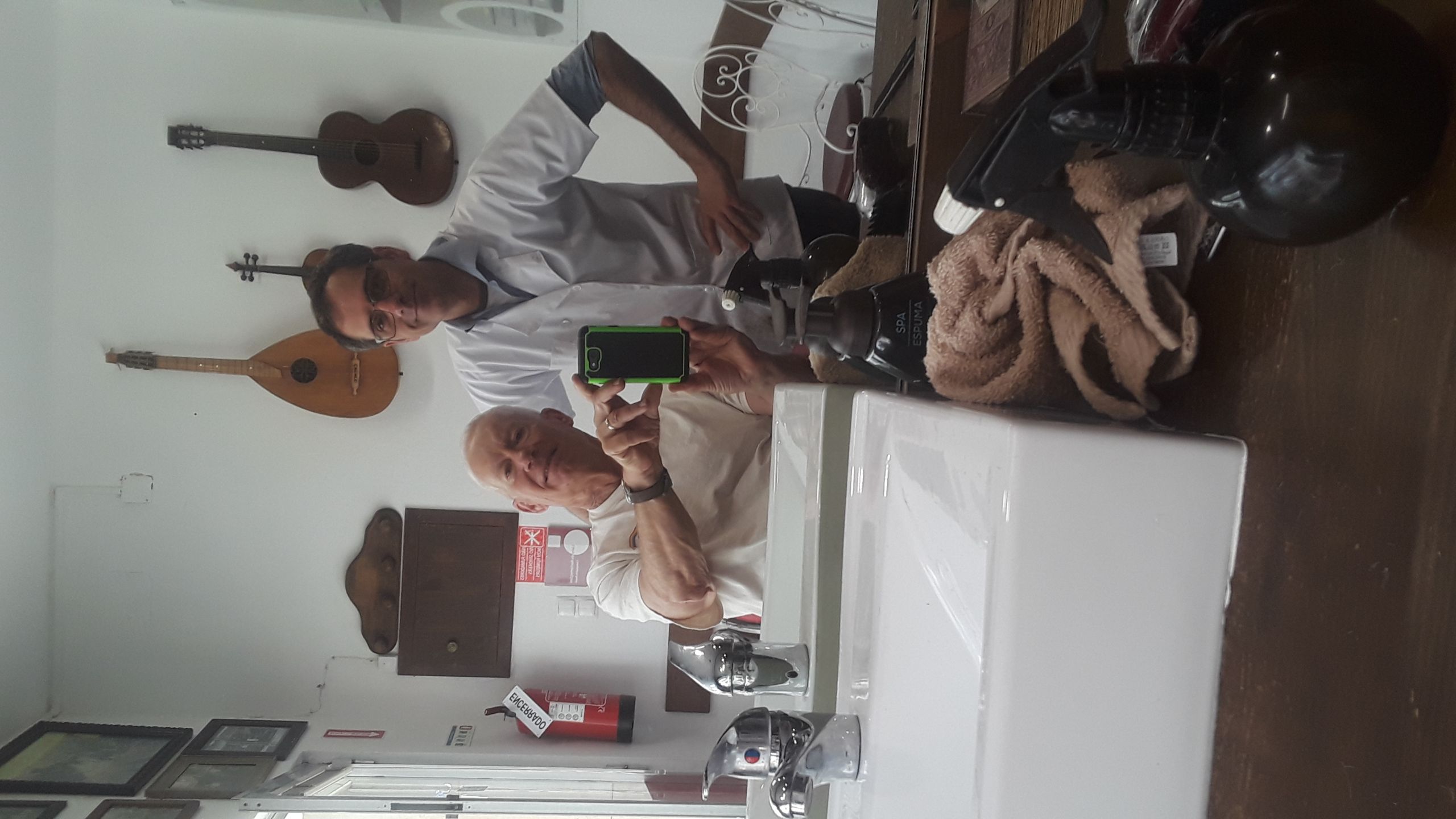
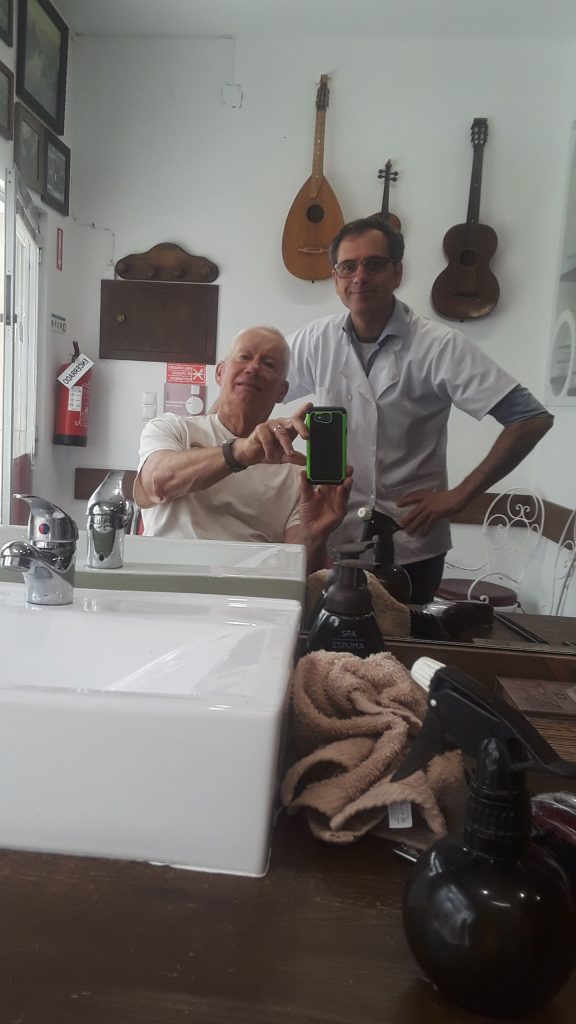
My barber and me after he finished his masterpiece in Lagos, Portugal.

I went to Lagos, Portugal, and got a the best haircut I’ve gotten in years. I won’t say I went to Lagos to get a haircut, but I did go to Lagos, and I did need a haircut, so I started looking for a barber. Barber shops appear fequently along the sidewalks of Portugal. Prices are cheap. The local men look trim and neat. A perfect chance, as they say, to sample the local wares.

Not, in noting this, to take anything away from the haircuts I usually receive from my wife. Those have the advantage of being free. In addition, her favorite (and only, I might add) customer usually sits without clothing, to keep the nasty little hairs from taking up residence beneath his collar. I often suggest to my wife that she also do her work without clothing, for no other reason than my overwhelming desire to keep her clothing from taking on my haircut. She demurs.

I feel extreme regret that I didn’t ask my Lagos barber’s name, in the excitement of paying 8 Euro (+2E tip) for his fine work, which included two electric passes, a comb-and-scissor round, and a straight razor finish. At home, we use a weed whacker.

In any case, if you should read this and find yourself in Lagos in need of a haircut, by all means visit Barbearia Vieira at Rua Conselheiro Joaquim Machado No. 38, or call 914-276-427 to find out if he has a line. He takes a break at noon for lunch.

Great people, great pais (country)

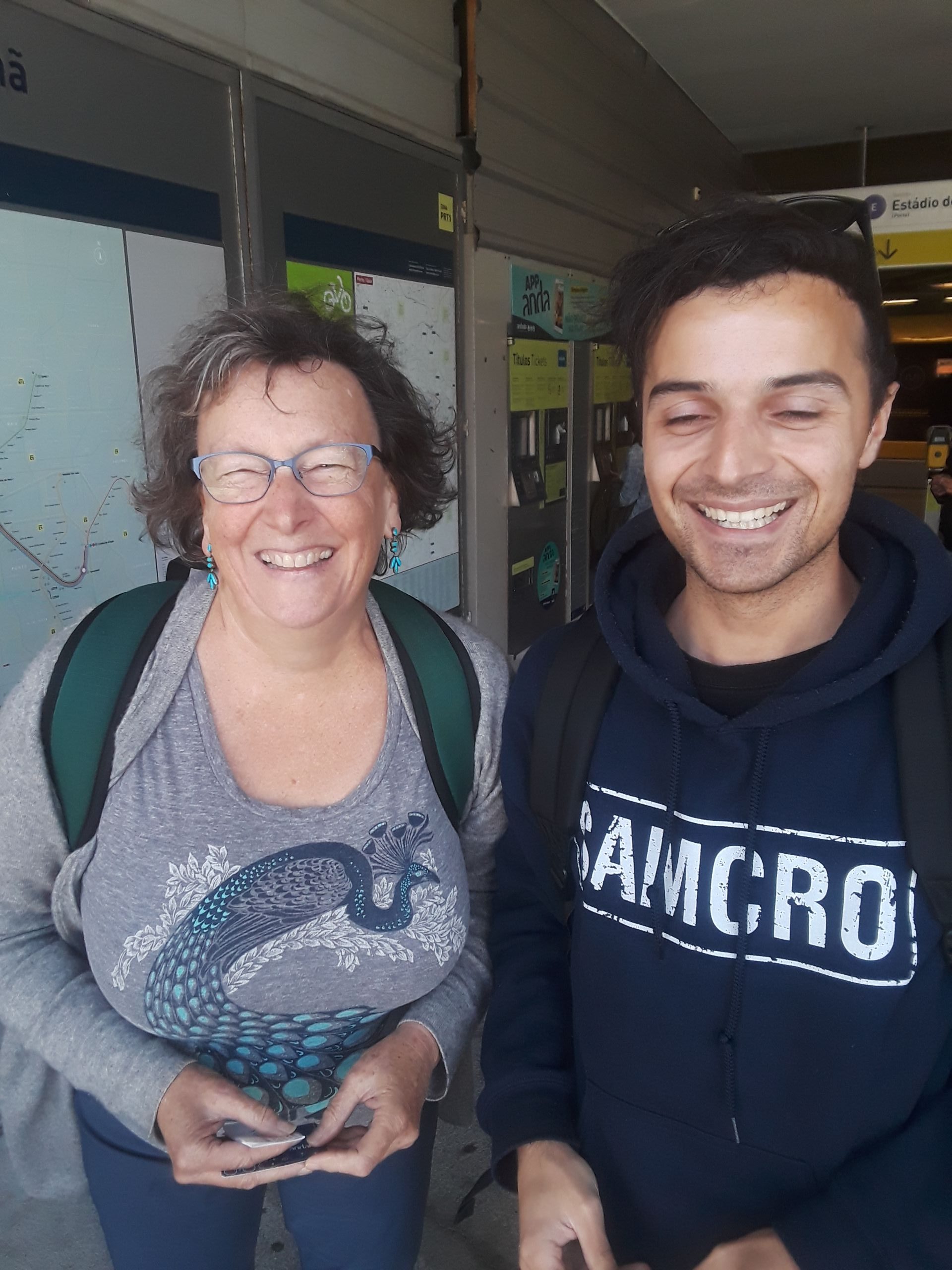
My wife, Kathy, and Digo, after he helped us with Metro ticketing.

Midway into our third week in Portugal, I have to say (not because someone has a gun to my head, but because it’s true), the people of Portugal are marvelous. Almost to a one, they are warm, welcoming, helpful and tolerant of the English-speakers in their midst. And we are a bunch, if you factor in north Americans and Brits and Aussies and others of the former British empire.

First, let me extend profuse thanks to Digo (“Like Diego, but no ‘E’,” he said), who came to our rescue five minutes after we stepped from the train in Porto. Our next task was to figure out the Porto Metro system, which operates on a completely different model than the one with which we had become familiar in Lisbon. Ever the soul of wit, I told my wife, “Looks like Greek to me.”

We’re standing in front of the ticketing machine, reading all the fine print about buying tickets based on zones of travel. The farther you want to go from where you stand, the more you need to load onto your travel card. It’s a lot to ask of people who have just arrived and don’t know bupkiss.

Digo to the rescue. He’s buying his own tickets at an adjacent kiosk, sees our plight, asks if we need help.

“A lot,” I say, smiling.

He leans in, asks the triage questions, helps us dial up the screen and select from several options, all in Portuguese. The most confusing one to us is the one about some tax and whether we want a refund and, if so, what our tax number is.

Digo helps us breeze past this irrelevancy, to the payment screen, and determine that, with this kiosk, we can pay by coin or card, but no paper currency. Have card, will travel (if you don’t get the Paladin reference, check out “Have Gun — Will Travel” on Wiki).

With our angel on hand, we soon held passes to the Metro, and Digo was off to another line and his own destination.

Such a sweet young man, who apologized for his limited English, which embarrassed us for our lack of more than 10 words of Portuguese. He said he had traveled himself, and benefited from the kindness of strangers, which was the real lesson here.

At one time or another, we all are strangers, and all are locals. I recall how excited I was to welcome foreigners to table at the restaurant my wife and I once ran in our small Oregon town. I understood, from past fumbling experience and frustration at having no language skills like the ones I had at home, what it must be like for them to sit at table and try to order from a menu printed in English.

Here, ground zero for European travelers seeking a good deal and a better time, almost every menu is printed in Portuguese, English, French and German. The Portuguese are prepared for visitors who speak a different tongue, knowing how much they can enhance that experience by meeting them where they speak. 

As we learned, students in Portuguese schools study their native language, but also are required to take another. 

As a high schooler in the U.S. in the 1960s, a foreign language was an option, not a requirement. Different worlds, different times. In a global economy, we all need to be a little multilingual.

Still, not all embrace this notion. At least not in the view of the Frenchman seated near us in the TimeOut dining hall in Lisbon. He travels often to the U.S on business and speaks fluent English. His wife speaks none. So it may not be true that almost everyone speaks a little English, it is probably true that almost everywhere, someone does. Our new French friend thought we were English, because that is how we first broached conversation. He observed that the English never bother to learn other languages.

We clarified our country of origin, but couldn’t dispute his conclusions as regards our own countrymen, even those who bother to leave Indiana for a European visit. I doubt that many Americans feel a need to study the language of the country they plan to visit. It comes from a chauvinist belief that everyone speaks English — or should.

Even though I may lack more than a smidgin of any other tongue, it bothers me to open by asking, “Do you speak English?” At the train ticket counter in Aveiro, I opened with a simple, stock Portuguese query, upon which the ticket seller said, “Don’t bother. I speak English.”

We felt for each other. He saw more benefit to himself than enduring my bastardized, minimalist attempts at engaging. And I felt relief that I didn’t have to struggle through that. 

For myself, I have long tried to approch host countries with a handful of basic phrases that can get me through situations that most visitors encounter.

My education prepared me, in weird ways, for travel in and around the Mediterranean. I grew up Catholic. We read Latin at Mass. I later studied Latin for a year, which helped me study English and, later, tackle Spanish after three years of German.

On my first trip to France, I felt totally handicapped by my lack of talent at that language. A few of my hosts were forgiving, but not all. It was a stark contrast with the situation in Portugal, where most guest service workers speak a little English. I’ve tried to add my basic kit here, but seldom feel a crying need for it.

(For the record, I find that learning a few basic infinitive verb forms for “to want,” “need,” “have,” “go,” “buy,” “eat,” and “drink,” plus a dozen or so key nouns — beer, bathroom, food, car, airport, bus, taxi, hotel, room, restaurant, etc. — will get you a long way.)

No matter how much or little language you know, the most important phrase to add — out of simple courtesy and respect to your hosts — is “thank you.”)

I was chatting with a shopkeeper in Aveiro, Portugal’s charming Venice knockoff, about local wines. She quickly discerned that I was not from Portugal, and in comfortable English, helped me select a bottle. We commiserated about our respective knuckleheaded presidents (she was from Brazil), and I apologized for not knowing much Portuguese.

“Have you learned a little?” she asked.

I said I had — “A very little” — and repeated the phrases for “I want” and “I need.”

“And obrigada,” I said.

She smiled. “Of course,” she said. “Thank you.”

She met her boyfriend, a Briton, while studing English in Manchester, England. I asked if he spoke Portuguese.

“No,” she said, “he’s lazy.”

But he’s still her boyfriend. For now.
Copyright © 2026 Chisel Chips

Theme by Anders NorenUp ↑