
Galleries

Responding to a response to a response to a letter sent to the world

I’m not much of a social media person. I like direct contact, which is why I will fire off an e-mail note to someone whose work or other actions has been particularly impressive. I believe in saying “thanks.”

When I recently read a letter to the editor in The New Yorker, I enjoyed the sentiments and felt a parallel with my own experience. So I looked up the writer, and found a web page (so old-school, right?), and (egads!) contact information.

I wrote a note.

And he wrote back.

And so it went.

I’ve pasted our exchange sequentially below. It left me feeling a sense of elation, that people like Ken Bates and his wife are out there in the world, working hard, doing what it takes to make a life — far beyond the inanity of our political yammering classes and their lumpish militants.

(from New Yorker, Nov. 23, 2020)
Obamacare and Me

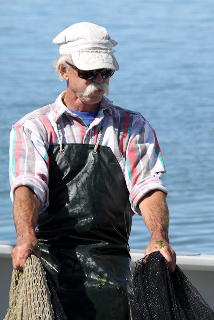
Barack Obama’s memoir of how the Affordable Care Act was passed illuminated the origins of a policy that has affected me profoundly (“The Health of a Nation,” November 2nd). I am a career commercial fisherman. In the nineteen-seventies, when I started working, fishermen and merchant mariners like me had federally supported health coverage through a scheme that had existed for decades. That scheme was terminated, in 1981, by Ronald Reagan. For a time, I bought private insurance, but eventually it became too expensive for my seasonally fluctuating income.

When A.C.A. insurance became available, I quickly signed up. A year later, I had a heart attack, and needed a cardiac stent. The plan I obtained through the health-insurance exchange covered my extensive medical bills and, as a result, my wife and I were able to keep our home, our truck, and our fishing boat.

I am now seventy. This summer, I spent a hundred and ten days on the ocean. No one gets where they are without the help of others. It was a pleasure to read this piece, which illustrated in such detail how I was helped by folks I will never get to meet.

Ken Bates
Eureka, Calif.

(My note to Ken, and our back-and-forth)

Ken

It was so great to see your letter in the current issue of the New Yorker. It mirrored my experience. I had insurance from my business in newspapers for many years, but after I went freelance in 1997, I had to pay my own. Rates kept going up, even though I never claimed a dime. Luckily, I stayed healthy (I work out, run, windsurf).

I watched progress of ACA. Why they waited until 2014, beyond me. But when it arrived, I benefited from supplements and coverage. One benefit was coverage for a colonoscopy after age 50. I got one, it found a large mass in my colon, which surgery removed. It was benign, but could have become cancer.

I’m now 70. I figure I’ve had a glorious additional six years because of the ACA, and even though my surgery under the pre-Medicare insurance cost my wife and me about $11,000 out of pocket, the insurance covered the other $41,000 of the bill. In each of those facts, so much to unpack.

We have been getting screwed by the insurance companies for years. Read “The Bitter Pill” in Time magazine to learn how they have worked the con. The ACA was not perfect (it kept insurance companies in the game), but it got us a step closer to Medicare for All. I’ve got it. Why doesn’t everybody?

Best of health and success to you,

Stu

Good evening Stuart,

Thank you so much for your comments concerning my letter to the editor in the New Yorker and taking the time to track me down. Your story concerning your experience with the ACA is exactly the reason that health care for the American public is so important. I have had the “opportunity” to experience health care costs both ways.

Before the ACA, my wife and I were uninsured, but we have led a very fiscally conservative lifestyle. Through the years we have tried to save as much money as we could. 9 years ago, after spending the summer trolling for salmon on the ocean, the two of us came home, switched fishing gears and proceeded to fish anchovies for 22 days straight, nose to the grindstone and no breaks.

3 days later, I got my hand smashed between two filthy fish bins in the back of a guy’s truck. That led to a MERSA infection, 8 days isolated in the hospital and surgery. Even with a 30% discount with a cash payment, the hospital bill erased most of the income from our summer and fall work.

Again, I really do appreciate the time you have taken to contact me. I am curious about your newspaper and writing work and where you wind surf. I have board surfed since fifth grade. Linda and I usually take a month in February to surf and hike in the desert in Baja California. The two of us live on a small island in Humboldt Bay. It has been frosty the last couple of nights and we expect it will be a cold one tonight. It is probably chilly where you are too.

Stay warm and stay healthy,

Ken and Linda

Ken,

So good to get your note, and so sad to read of your encounter with the medical-insurance complex. What a tragedy, that someone who can work so hard to make a buck finds it stolen because of an accident for which he needs care. I say stolen, because I believe that is what it is. The people who fixed your hand did a good job, and probably got a decent check for it. But the real theft was the skim that the hospital took, and all the other expenses they loaded into that bill.

The chief exec at a small hospital in The Dalles makes over $700,000 a year. Does he deserve it? Ha! Guess I know the answer.

Yours sounds like a lovely life, nonetheless. I would love to meet you and Linda some day. I almost went to school at Humboldt, shifted to Southern Oregon, finished my journalism studies at Oregon. Ended up back in Ashland for 14 years, working at the Medford paper, hiking all over southern Oregon and northern California. Love it down there.

When I was a kid, I wave-surfed in SoCal, but too many people for me back in the late ’60s, so I ran away to Oregon and never looked back.

My wife and I are taking a winter break to spend some time in Summerland, south of Santa Barbara. No plans for our return route. If we detour along the coast, I’ll give a call. Maybe we can grab a beer (if the Covid situation permits).

Best to you both,

Stu

Good morning,

If Linda and I had to pick a place to hang out in Southern California, it would be Summerland. I grew up surfing on that stretch of coast, and I fished lobsters out of Santa Barbara for about ten seasons. We have a ton of friends there including five or six commercial fishermen that are in our code ( radio) group when we fish salmon every summer.

If you find yourselves driving through Eureka, let us know. We have a guest cabin here on the island, and would be happy to put you up for a night. Otherwise we would love to bring you over to the island for a visit; the only way to get here is by boat.

Happy thanksgiving,

Ken and Linda

A fog from a fire and the fog of arrogance and the fog of incompetence and …

I love fog. I’ve got fog, but I don’t love this fog. This fog is the devil spawn of fire. Smoke, shoved west from its forest home by flames a-billion, then back east by a shift in pressure and wind.

Now it’s ours to enjoy, and not so much the folks to our west. It’s rated hazardous, on the scale of deep breath-to-stop breathing.

North to south, our state is ablaze. Nearly a half-million people have evacuated their homes. They have gone … somewhere. God knows where, but I don’t. They might be at Safeway.

We live just north of Mt. Hood, the blessed 11,000-foot barrier between our county and the burning county to the south. Maybe that county’s residents fled here. It seemed, if that was the case, that they had first decided to stock up in the middle of our Covid-19 pandemic at Safeway.

Mid-day on a September Friday in which nobody was going anywhere for fun, for lolling by a lake, for sipping a beer and dipping one’s toes in chill water, for grilling mashed pork in the skins of mashed pork, I’m standing six deep in a line to buy eight items.

I would love to go camping, but who wants to do that when the smoke is beyond healthy, even for my dog. Satchel tired out earlier than his usual point of fatigue when I took him up into the gloom to chase his sticks and takes his drinks in Indian Creek. (Sorry, that’s its name; no offense intended.)

So we hunker down further, again, more, after months of hunkering from Covid-19. Now we open our doors, and we can see the attacker. We peer out at the smoke lowering like the invasive gloom of a John Carpenter movie (“The Fog”. If Adrienne Barbeau emerges, I’m fine), and wonder if we should inhale, or hold our breaths until all this abates.

Or pack our cars with essentials and legal documents before we flee for our lives.

All that notwithstanding, my wife is off to one of her opportunities to cook. She will endure untold indignities and suffer ridiculous fatigue for the chance to stand before a stove and paint a masterpiece.

She is offering her labors to support a local education foundation. The people for whom she donates time seem to have no clue that it takes a kitchen and utensils and flatware and recycling and trash to make it all happen.

Numerous calls to the winery in charge of provisioning liquid excellence go unreturned. Should my dear show up there to receive their contribution, or not? Eventually, one of their beknighted tribe returns a call.

No, she does not know how many bottles of each wine to assemble for my wife to pick up.

“An email was sent.”

“Sorry, didn’t get it.”

My dear is so restrained. She does NOT say, “Well, talk to the idiot to whom I sent the email and figure it out, because you’ve had a FUCKING WEEK to do that, and I’ll be there in 10 minutes.

No, she says, “thanks for the call.”

At the other end of the line sits the definition of arrogance. If you are paired into an enterprise designed to elevate your brand and share your product, please, do your part. Your wine will not arrive in the glass by divine grace.

No matter, the people who are blessed to view and consume this thoughtfully created meal when it arrives before them will appreciate it mightily. But not nearly enough. If they do, they never say. It is all hay to cattle such as they. The winemaker, for whom a plate was set, fails to show. “Fucking great,” one of the professional drug dealers says as he and his team of profiteers depart.

Fifty or a hundred years from now, the auctioneers at Christie’s will collect bids from people who have heard about this evening, and wish to buy a memory of it.

Millions will change hands.

And my lovely bride will be dead.

But I will be there with her, in the beyond, to smile down on the people who seldom appreciate genius in their own time, because they are too busy celebrating (or trying to get others to celebrate) the geniuses they imagine themselves to be. Opioids will do that to you.

Sigh.


The finest line

When is it abuse, and when is it guided introduction to the mysteries of life? When is it “criminal,” and when is it a rite of passage?

There’s a fine line between the two. A sense of gratitude on the part of the student probably tilts the answer. Follow this link to read a recent examination of such an experience, published in The Maine Review.

Letter to my son and his lady friend after a long and late night with

Dear Max and Hannah (please share this with her; I don’t have her e-mail),

We’re alive. Up, finally, and pouring coffee to the veins. Arrived home at 11:30, then decompressed with whiskey and snacks until 1, then bed. Ugh. Long day, but so worth it. Wanted again to thank you both for the lovely gift of art (performance art). It was magical, to see a live performance of the play, so well done, with such good company.

On that note, and linked back to your table thoughts on college education, degrees, BA vs MA/MS vs. … 3-month certificate. It’s a fascinating debate, a bit now of a pendulum swing, which is depressing interest in the humanities (which give us “Fiddler on the Roof”) to the favor of CTE (career and technical ed, as you must know).

Here’s a piece in today’s NY Times addressing that …

https://www.nytimes.com/2020/01/11/opinion/sunday/academics-humanities-literature-canon.html?action=click&module=Opinion&pgtype=Homepage

and an earlier piece, if you’re a glutton for punishment, on the same topic.

https://www.nytimes.com/2018/08/08/opinion/oh-the-humanities.html


I’ve always been a humanities person, but got nudged toward a practical application (journalism), not exactly engineering, but clearly with a professional application in mind.

I recall the prof who thus nudged me noting that an English degree wouldn’t lead to a decent job. And, later, another English prof advising me that I could become a “hack” (i.e. journalist), or pursue art (i.e. literature, and … well, he didn’t do the economic calculus that his colleague had, which may have been why, no matter how much I loved literature, I tilted toward journalism). I should note that the latter gentleman was a lovely gent of Persian descent, who I knew as M. Zavarzadeh. I Googled him. His first name was actually Mas’ud.

Back in the day, there were no journalism degrees or programs. People came to it from the humanities, after studying all the things that go into good journalism — sociology, history, poli sci, literature, and (tech tilt here) economics.

For your world (K-12), there’s a case to be made that some students really may prefer a CTE track and get on with it. But who decides? And how do we decide? It seems a crime to deprive them of the opportunity to explore the humanities, to see if that resonates with them, before somehow (the test?) determining that they should take shop class. That’s how they did it back in my day — the kids with better grades and more dutiful attention to their studies got into the college-prep track. Everybody else took home ec and auto shop. Human potential is so mysterious. People who are really good with their hands and mechanically inclined can also be good thinkers on other topics. Farmer Wendell Berry comes immediately to mind. The duality is complementary, not competitive. It’s not either/or, but both/and more.

So much for a Sunday morning brain dump. Take two aspirin and call me in the morning.

Exit signs

My dog and I were out in the circle early this morning, when my neighbor emerged from her house with her dog, Lucky.

Jane had been laid off several months earlier from her admin job, the same day her husband was laid off from his drafting job, each from the same employer.

He got a new job, in San Diego. He stays in a condo they own down there.

We live 1,082 miles north, in Oregon.  His wife stays in the house where their two kids are finishing school.

They get together, every so often.

She said she could move down there after the last kid leaves home, in two years.

“And keep your house here?” I asked.

“Probably,” she said. “If we sold, we couldn’t afford to buy another one if we decided to come back.”

Jane told me the same company that fired her as an employee (with benefits), is the company that rehired her on a contract basis (no benefits). She’s working at that company, but being paid through a staffing agency.

She wasn’t hired to do the same job. It was a new thing. She goes around the building and checks the EXIT signs to make sure they’re lit.

“That’s good,” I said, “so I know where to go if I ever need to get the hell out of your building.”

“Right,” she said. “Or the next time I get laid off.”

She turned and walked back inside with Lucky. She had to finish getting ready for work.

Copyright © 2026 Chisel Chips

Theme by Anders NorenUp ↑